

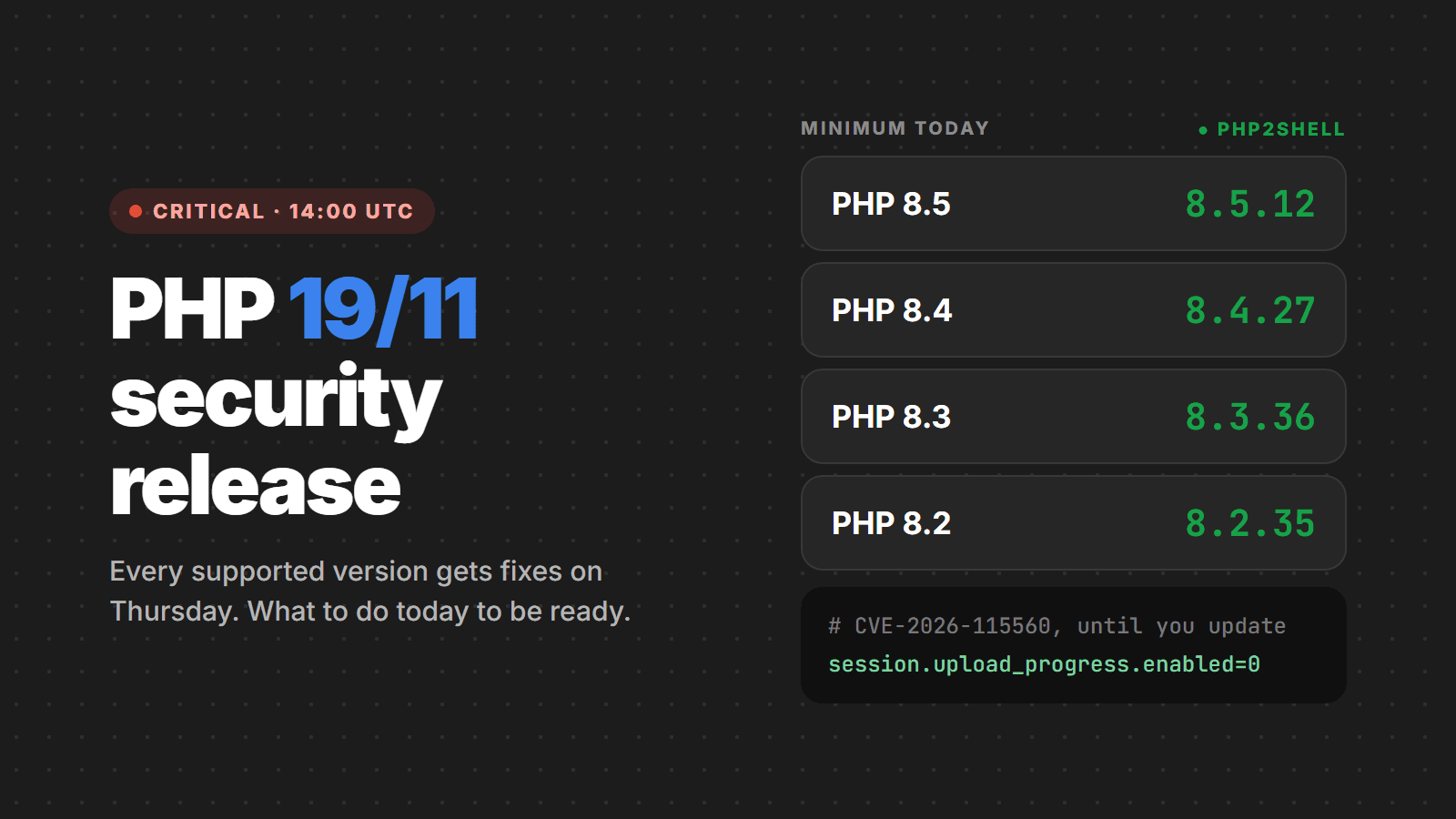
On November 18, 2026, the PHP security team published an unusual notice: this Thursday's regular releases, on November 19, will ship as security updates with a highest severity of “critical”. The release is scheduled between 14:00 and 14:30 UTC (9:00 to 9:30 AM US Eastern) and covers every supported PHP version.
The announcement itself makes an important point: the issues rated critical only affect non-default configurations or uncommon setups. In other words, this is not another PHP2Shell. Even so, the team asks everyone to be ready to update as soon as the releases are out. The fixed version numbers and technical details will only be published alongside the release.
Summary for those in a hurry
- When: Thursday, 11/19/2026, between 14:00 and 14:30 UTC.
- Which versions: every supported line, that is PHP 8.2, 8.3, 8.4 and 8.5.
- Severity: the highest is critical, but it requires a non-default configuration or an uncommon setup.
- One flaw is already known: CVE-2026-115560, a remote code execution vector in session upload progress, announced on 10/23 and only fixed now.
- What to do today: make sure the PHP2Shell fix is in place (8.5.12, 8.4.27, 8.3.36 or 8.2.35), turn off
session.upload_progress.enabledif you can, and get your update path ready for Thursday.
What the announcement says (and what it does not say yet)
| Item | What we know |
|---|---|
| Date and time | 11/19/2026, 14:00 to 14:30 UTC |
| Affected versions | All supported (8.2 to 8.5) |
| Highest severity | Critical, in non-default configuration or uncommon setups |
| Release type | Regular four-week cycle, not an emergency release |
| Fixed version numbers | Not published yet |
| Full CVE list | Not published yet |
Unlike October, when PHP had to bring the release forward after a leak, this time the notice came a day early and within the normal schedule. That is the process working as intended: giving hosting providers, Linux distributions and infrastructure teams time to get ready.
The flaw we already know about: CVE-2026-115560
Two days after PHP2Shell, on October 23, PHP published an informational advisory about a remote code execution path in the session upload progress feature, which lets you track an upload's progress through the session. At the time, the team said it would handle the issue in the regular cycle and publish the full advisory for CVE-2026-115560 with the next release, which is the November 19 one.
Exploiting it requires an uncommon combination, with all three conditions at once:
session.serialize_handleris set tophp_binaryorphp_serialize.- The application switches it to
phpat runtime, withini_set(), before callingsession_start(). session.upload_progress.enabledis still on, which is the default.
Applications that never change the session serializer at runtime can keep the feature on. There is no CVSS score or list of affected versions for this CVE yet, and it is not known whether it is one of the issues rated critical in the November 18 notice.
Do not confuse it with PHP2Shell
| PHP2Shell (10/21) | 11/19 release | |
|---|---|---|
| CVEs | CVE-2026-109618 and CVE-2026-109619 | CVE-2026-115560 and others not yet disclosed |
| Score | CVSS v4.0 9.2 | Critical (score not published yet) |
| Who is affected | Any PHP serving web requests | Non-default configurations or uncommon setups |
| Release | Emergency, brought forward after a leak | Regular cycle, announced in advance |
| Fixed versions | 8.5.12, 8.4.27, 8.3.36, 8.2.35 | Published on 11/19 |
If your server is not yet on one of the versions that fix PHP2Shell, that is today's priority, not tomorrow's. There have been reports of scanning and exploitation of those flaws since October. We cover everything in our PHP2Shell guide.
Step 1: today, check where you stand
The command-line PHP is not always the one serving your site. Check the binaries, the services and, if possible, your site's own diagnostics page (in WordPress: Tools > Site Health > Info > Server).
# installed versions and active FPM services
php -v
systemctl list-units --type=service | grep -i php

# Debian / Ubuntu: does the package already have the PHP2Shell fix?
zcat /usr/share/doc/php8.3-fpm/changelog.Debian.gz | grep -E "CVE-2026-10961(8|9)"

# RHEL / AlmaLinux / Rocky
rpm -q --changelog php-fpm | grep -E "CVE-2026-10961(8|9)"
Then check whether your application fits the CVE-2026-115560 scenario:
# current serializer and upload progress settings
php -i | grep -E "session.serialize_handler|session.upload_progress.enabled"
grep -rn "serialize_handler\|upload_progress" /etc/php/

# does the application switch the serializer at runtime?
grep -rnE "ini_set\(\s*['\"]session\.serialize_handler" /var/www
Keep in mind that php -i shows the command-line configuration. The values that apply to the site live in the FPM or Apache php.ini and in the pool files.
Step 2: today, apply the mitigation if it makes sense
For CVE-2026-115560, PHP recommends turning off session upload progress until the update. If you already did this because of PHP2Shell (the same setting was on the mitigation list for CVE-2026-109619), keep it as is.
; PHP-FPM: /etc/php/8.x/fpm/pool.d/www.conf
php_admin_value[session.upload_progress.enabled] = 0

; or in php.ini
session.upload_progress.enabled = 0
The setting must apply before the request is parsed, so use php.ini, the FPM pool or the web server configuration. It does not work with ini_set() or .user.ini. Then restart every PHP worker. The side effect is that upload progress bars built on this feature stop working; most sites do not use it.
Step 3: today, get your update path ready
- Inventory: list every server, container, control panel and product that ships PHP, starting with the ones exposed to the internet.
- Maintenance window: set aside Thursday after 14:30 UTC to update and restart services.
- Docker: make sure your pipeline can rebuild and publish images as soon as the official
phpimages are updated. - Distributions: Debian, Ubuntu, RHEL and derivatives usually patch the package without changing the version number. Follow your distribution's security notices.
- Shared or managed hosting: ask support when the update will be applied and whether every version in the PHP selector will be patched.
Step 4: Thursday, update and restart
As soon as the releases are out and reach your package manager, update and restart the PHP processes. As long as an old worker is alive, it keeps running the vulnerable code.
# Debian / Ubuntu (adjust to your version)
sudo apt update
sudo apt install --only-upgrade 'php8.3*'
sudo systemctl restart php8.3-fpm
sudo systemctl restart apache2   # if you use mod_php

# RHEL / AlmaLinux / Rocky
sudo dnf upgrade 'php*'
sudo systemctl restart php-fpm httpd

# Docker: pull the new base image and rebuild
docker build --pull -t my-app .
After updating, read the advisory for each CVE. If none applies to your configuration, you can undo the upload progress mitigation. If one applies and the server was exposed, look for signs of compromise as we did for PHP2Shell: PHP processes spawning shells, new .php files in the public folder and cron jobs nobody created.
What about PHP 8.1 or older?
The PHP project only provides security support from 8.2 onward, and 8.2 itself reaches end of life on December 31, 2026. If you are on 8.1 or older, you will not get this update officially. The options are the same as in October: a patched package from your distribution or an extended support vendor, or a version upgrade. If you are still on 8.2, start planning the move to 8.3 or newer now.
Checklist
- PHP2Shell fix applied (8.5.12, 8.4.27, 8.3.36, 8.2.35 or a distribution package with the CVEs in its changelog)
- Inventory of every server, container and product with PHP
- Checked whether the application changes
session.serialize_handlerwithini_set() session.upload_progress.enabled = 0inphp.inior the pool, with workers restarted- Maintenance window booked for 11/19
- Docker image pipeline ready to rebuild
- Hosting provider and vendors notified
- Plan to move off PHP 8.2 (and anything older) before 12/31/2026
We will update this post with the fixed versions and CVE details as soon as PHP publishes the release.
Sources
- PHP.net: Upcoming Critical PHP Security Release (11/18/2026)
- PHP.net: Informational advisory: Session upload progress (10/23/2026)
- GitHub: GHSA-6wmf-4rv5-p3rp (CVE-2026-109619)
- Aikido: PHP schedules a critical security release for 19 November
- PHP.net: PHP2Shell advisory (10/21/2026)
Need help?
Not sure which PHP your site runs, whether PHP2Shell has been fixed, or you have no time to follow Thursday's update? Talk to us: we check the version and configuration, apply the mitigation and update without taking the site down. And if you would rather leave this kind of maintenance to the people who run the server, see CPW hosting.