

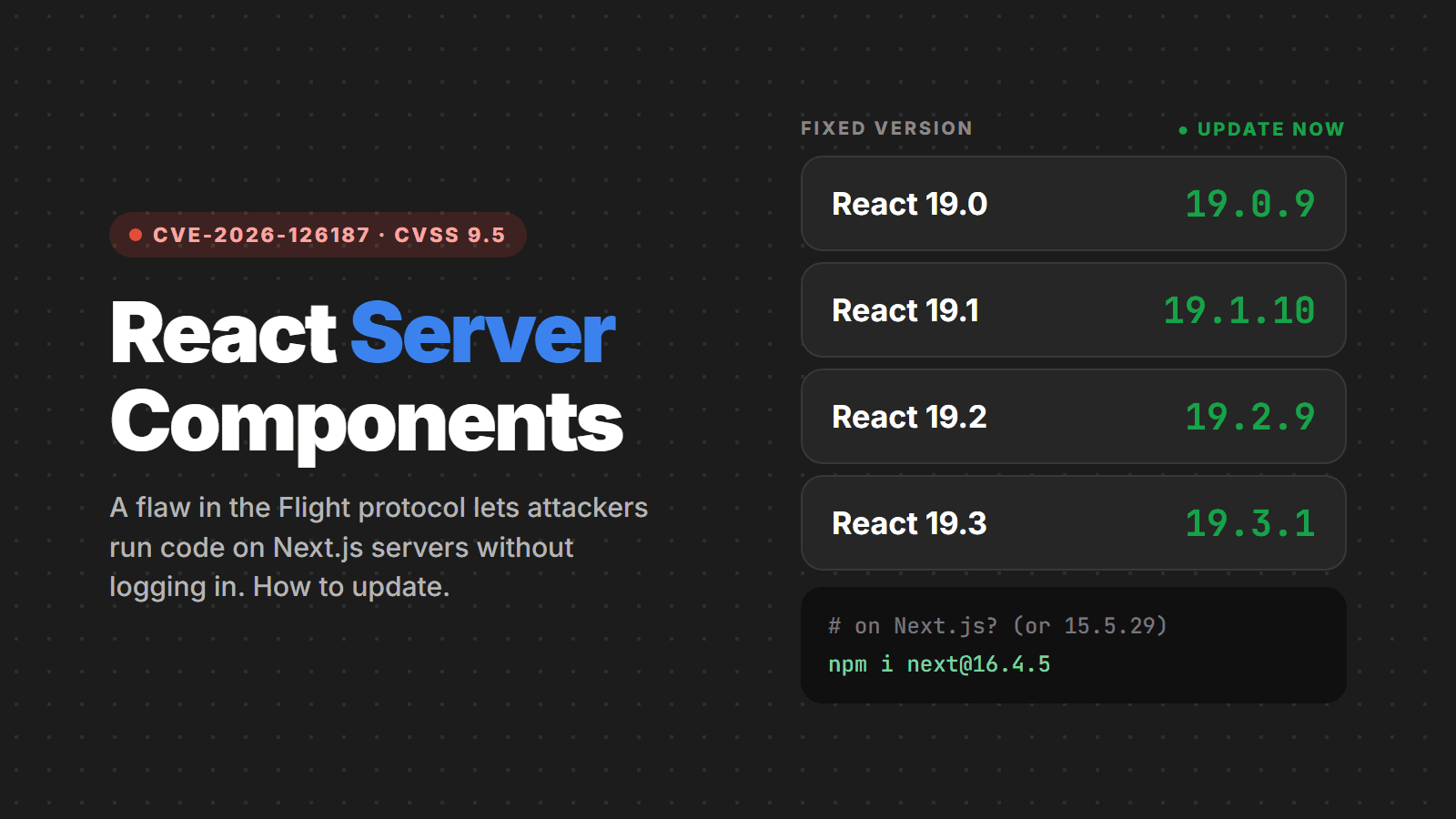
On November 10, 2026, GitHub assigned CVE-2026-126187 to a critical flaw in React Server Components (RSC), the part of React that runs on the server and powers the Next.js App Router, React Router in RSC mode, Waku and the Vite and Parcel RSC plugins. The flaw allows remote code execution without logging in and is rated 9.5 on CVSS v4.0. React's fix had already shipped on October 14, without a CVE number, which is why many teams have not updated yet: dependency scanners (Dependabot, npm audit) only started flagging it now.
It is the second serious flaw in the same protocol in less than a year. In December 2025, React2Shell (CVE-2025-55182, score 10) was exploited within hours of disclosure and left hundreds of servers mining cryptocurrency. If you only patched React2Shell, you are still vulnerable to this new flaw.
Summary for those in a hurry
- Update React's server packages (
react-server-dom-webpack,react-server-dom-turbopackandreact-server-dom-parcel) to 19.0.9, 19.1.10, 19.2.9 or 19.3.1, depending on your release line. - Using Next.js? Move to 16.4.5 or 15.5.29. Next.js ships its own copy of these packages, so updating only
reactandreact-domdoes not fix it. - Not affected: React apps that run only in the browser (Vite SPA, Create React App), static exports (
output: 'export') and apps that use only the Pages Router. - There is no configuration mitigation. WAF rules help as a stopgap, but the fix is to update, build again and deploy.
- As of November 13 there was no confirmed exploitation, but public repositories claiming proof-of-concept code are already circulating.
What the flaw is
When a Server Component finishes rendering, the server sends the result to the browser in its own format called Flight. It is a stream of rows: each row has a header with an ID, a type and, for binary data, the size in bytes of the content that follows.
The problem was in how the server wrote typed arrays (Uint8Array, Float32Array and the like) larger than 2048 bytes. Instead of copying the data, React kept a reference to the application's own ArrayBuffer. If that buffer was transferred somewhere else along the way, it became empty, and the server wrote the header promising N bytes but sent none, with no error and no log.
On the other side, the Flight reader trusts the declared size. It consumes the next N bytes, which are actually the following rows of the response, and resumes reading from the wrong position. If part of those bytes comes from an attacker-controlled value, the attacker can get their text parsed as protocol, including a row that tells the client to load a module from the application bundle. This row "smuggling" is what leads to code execution. In the weakness catalog the flaw is listed as CWE-502, deserialization of untrusted data.
Who is exposed
React itself says the scenario is rare: the response must carry several typed arrays over the same buffer and some attacker-controlled value. In practice, the best-known case is Next.js with Cache Components: a "use cache" function that returns several typed arrays. Vercel published its own advisory for it (GHSA-673q-mjm6-r5xr), also rated 9.5.
| Environment | Status |
|---|---|
| Next.js 16.0 to 16.4.0 with App Router and Cache Components | Affected, top priority |
| Next.js 15.x and 16.x with App Router | Ships the vulnerable package, update |
React Router RSC mode, Waku, @vitejs/plugin-rsc, @parcel/rsc, RedwoodSDK | Affected if react-server-dom-* is below the fixed version |
| Next.js with Pages Router only | Not affected by this flaw |
Next.js with output: 'export' | Not affected (no server) |
| Browser-only React (Vite, CRA, React Native) | Not affected |
"Rare" is no reason to wait. Deserialization exploits tend to get easier once someone publishes a patch analysis, and that is exactly what happened with React2Shell: in December 2025 attacks started on the day of disclosure.
Do not confuse it with React2Shell
| React2Shell (Dec 2025) | CVE-2026-126187 (Oct-Nov 2026) | |
|---|---|---|
| CVE | CVE-2025-55182 | CVE-2026-126187 |
| Score | CVSS 10.0 | CVSS 9.5 |
| Where | Parsing of Server Function calls | Writing typed arrays in Flight |
| Condition | Any app with RSC | Responses with several typed arrays and attacker data |
| Exploited | Yes, at scale (in CISA KEV) | Not confirmed as of Nov 13 |
| Fixed versions | 19.0.1, 19.1.2, 19.2.1 | 19.0.9, 19.1.10, 19.2.9, 19.3.1 |
If your project stopped at the versions that fixed React2Shell, it is still vulnerable to this flaw and to a series of denial of service flaws published throughout 2026 in the same packages.
Step 1: find out which versions you use
# Next.js version
npx next --version

# React server packages (including indirect dependencies)
npm ls react-server-dom-webpack react-server-dom-turbopack react-server-dom-parcel
pnpm why react-server-dom-webpack

# search the lockfile
grep -E "react-server-dom-(webpack|turbopack|parcel)" package-lock.json pnpm-lock.yaml yarn.lock

# Cache Components enabled? "use cache" functions?
grep -rn "cacheComponents" next.config.*
grep -rln "use cache" app src
In Next.js, the react-server-dom-* packages are compiled into next itself, so the Next.js version is what matters. In other frameworks, check the version your lockfile resolves.
Step 2: update
| What you use | Fixed version |
|---|---|
react-server-dom-* 19.0.x | 19.0.9 |
react-server-dom-* 19.1.x | 19.1.10 |
react-server-dom-* 19.2.x | 19.2.9 |
react-server-dom-* 19.3.x | 19.3.1 |
| Next.js 16.x | 16.4.5 or newer |
| Next.js 15.x | 15.5.29 or newer |
| Next.js 16.0 to 16.3, 15.0 to 15.4, 14 or older | No fix on these lines: move to 16.4.5 or 15.5.29 |
# Next.js
npm install [email protected]      # or [email protected] on the 15 line

# React Router RSC, Waku, Vite/Parcel RSC: update the framework and the server package
npm install [email protected] [email protected] [email protected]

# make sure no old copy is left
npm ls react-server-dom-webpack react-server-dom-turbopack react-server-dom-parcel
Then create a new build and deploy it. Redeploying the old build or restarting the container does not help: the vulnerable code is still inside the image. Take the chance to shut down previews, staging environments and forgotten demos still running the old version.
Step 3: if you cannot update today
There is no flag that turns off the vulnerable part. What you can do until the upgrade ships:
- Do not pass several typed arrays over the same buffer from a Server Component or a
"use cache"function to the client. Copy before returning, for exampleview.slice()instead ofview.subarray(). - Turn on your provider's WAF rules (Vercel, Cloudflare, Netlify and others published RSC rules), knowing that React and Vercel warn they do not replace the update.
- Restrict outbound traffic from Node.js servers so that, even with code execution, an attacker cannot download tools or reach command servers.
Step 4: look for signs of attack
If the application was exposed to the internet on a vulnerable version, look for anything unusual the Node.js process did:
- Child processes of
nodesuch assh,bash,whoami,id,curl,wgetorncon production servers. - New files in
/tmp,/var/tmpor/dev/shmcreated by Node.js and executed shortly after. - Strange outbound connections, especially to the cloud metadata address (
169.254.169.254), tunnels such as*.trycloudflare.comor IPs on non-web ports. - Secret reads: access to
.env,/proc/self/environ, Kubernetes tokens or cloud credential files. - In proxy logs, bursts of
POSTrequests with thenext-actionorrsc-action-idheaders from a single IP ending in 5xx errors. - High, constant CPU usage, which with React2Shell was a sign of a cryptominer.
If you find anything, isolate the server, keep the logs, deploy a new clean build (do not try to clean the compromised container) and rotate every secret the application could read: environment variables, database passwords, API keys and cloud credentials.
Checklist
- Inventory of every project with Next.js App Router, React Router RSC, Waku or RSC plugins
- Next.js on 16.4.5 or 15.5.29 (or newer)
react-server-dom-*on 19.0.9, 19.1.10, 19.2.9 or 19.3.1 in other frameworks- Lockfile updated, new build created and deployed (Docker images included)
- Old previews, staging and demos updated or shut down
- Dependabot and
npm auditrun again, now that the CVE is in GitHub's database - Logs reviewed for the signs above
- Secrets rotated if there is any sign of attack
Sources
- GitHub Advisory: CVE-2026-126187 (GHSA-xqc2-xf4c-x3h3)
- StepSecurity: CVE-2026-126187, React Flight RCE
- ThreatDefence: React Server Components RCE, patching and hunting
- Cloud Security Alliance: Next.js out-of-band patch (use cache)
- React: Critical Security Vulnerability in React Server Components (React2Shell)
Need help?
Not sure which projects use Server Components, which React version ships inside your Next.js or whether that forgotten preview is still online? Talk to us: we take inventory, update and ship a new build without taking the site down, and review the logs for signs of attack.